
Back to Capacity
What is education for? Drawing on the history of Black educational advancement after emancipation and contemporary learning experiences, this inaugural essay introduces Still Rising Institute’s exploration of how education cultivates capacity, agency, and the ability of individuals and communities to shape their futures.
We have become exceptionally skilled at studying educational systems.
We study interventions and outcomes.
We define accountability standards and evaluate fidelity to implementation models.
We try to determine what is measurable, what is scalable, and what works.
What often receives less attention is the human experience of being educated.
Students, whether they are beginning their first day in a Head Start program, working with a reading coach, sitting in a middle school classroom, or participating in an apprenticeship, do not experience education as a product, or even as a system.
They experience it as a series of relationships.
As the teacher who noticed their glasses were broken and the resource officer who found a way to help replace them.
As the classroom where they felt safe enough to make a mistake, and another where they never felt safe enough to be right.
As the mentor who expanded their sense of possibility.
As the community that invested in them or the institution that merely processed them.
As a collection of experiences that gradually shaped what they believed about themselves, their future, and their place in the world.
Systems manage education.
People experience it.
And the experiences people carry with them are rarely organized the way systems are.
They are remembered through relationships.
Through moments of encouragement and disappointment.
Through opportunities gained or denied.
Through the people and experiences that shaped their confidence, aspirations, expectations, and understanding of their place in the world.
These distinctions matter.
The Question Beneath the Debate
Most educational debates focus on outputs.
We talk about reading levels, proficiency rates, funding formulas, accountability systems, college readiness, workforce development, testing, technology, school choice, and artificial intelligence.
But before discussing outputs, we need to ask a more foundational question:
What is education for?
Every educational system is organized around a purpose.
Families may seek security.
Communities may seek agency.
Educational institutions may seek access, attainment, knowledge, or citizenship.
Employers may seek productivity.
Governments may seek stability.
None of these purposes are inherently wrong.
But they are not identical.
The challenge is not that multiple purposes exist.
It is that they are not always weighted equally.
The institutions with the greatest authority often have the greatest influence over how success is defined, which outcomes are measured, what experiences are prioritized, and ultimately what kinds of people educational systems are designed to develop.
Perhaps this is why so many educational debates feel incomplete.
We debate methods before clarifying purpose.
We discuss outcomes before reaching agreement on what those outcomes are meant to produce.
And beneath many of those conversations lies a fundamentally human concern:
Will our children be okay?
Not simply in school.
Not simply in a job.
But in life.
Learning from Our History
To understand education today, it is worth revisiting one of the most remarkable educational movements in American history.
Following emancipation, formerly enslaved people pursued education with extraordinary urgency.
Across the South, Black communities donated and raised money, purchased land, contributed labor, built schoolhouses, trained and recruited teachers, and advocated for educational access for all citizens (Anderson, 1988).
Thousands of schools emerged through the combined efforts of Black communities, churches, missionary organizations, the Freedmen’s Bureau, and emerging public school systems. These schools were often attended by both children and adults eager to learn, leading to extraordinary outcomes (Anderson, 1988; Franklin & Moss, 2000).
In 1880, approximately 76% of Southern Black Americans aged ten and older were unable to read or write. By 1900, Black illiteracy had fallen to approximately 48%, and by 1910 it had fallen to approximately 33% (Margo, 1990).
Stop and think about that for a moment.
Within a generation or two of emancipation, communities that had been systematically denied literacy reduced illiteracy by more than half.
That is not a typical educational improvement story.
It is the story of a determined people using education to expand their collective capacity for ownership and agency, shape their own futures, build institutions, and advance their communities in the face of extraordinary constraints.
More importantly, it forces us to reconsider what these communities believed education made possible.
The people driving this movement were not responding to established pathways.
The few pathways and opportunities that existed rarely led to the futures they envisioned for themselves, their families, or their communities.
They were not being recruited into thriving institutions.
In many cases, they were building the institutions their communities needed.
Community investment came before widespread opportunity.
Community investment came before broad access.
Community investment came before economic reward (Anderson, 1988).
If education were primarily about pathways, opportunity, and participation in existing systems, Black Americans would not have achieved what they did.
Yet they did.
They organized.
They learned.
They taught.
They built (Anderson, 1988; Woodson, 1933).
The evidence suggests they understood education differently than we often describe it today.
Education was not merely a route to opportunity.
It was a means of developing the capacity to create opportunity.
It was not simply preparation for participation in existing institutions.
It was preparation for building new ones.
When we look at education through the lens of literacy rates alone, we see improvement.
When we look at education through the lens of a people building collective capacity to shape its future, we see cultivation.
From Opportunity to Capacity
The story of Black education following emancipation raises an important question:
If educational opportunity was limited, uncertain, and often actively resisted, why did communities invest so heavily in education?
Because they understood education as something more foundational than mobility alone.
Education was certainly connected to opportunity.
But it was also connected to capacity.
The capacity to read.
The capacity to teach.
The capacity to organize.
The capacity to lead.
The capacity to build institutions.
The capacity to sustain.
The capacity to define a future that did not yet exist.
Many of today’s educational conversations focus understandably on outcomes: graduation rates, college enrollment, workforce readiness, earnings, and economic mobility.
These measures matter.
But they may not fully capture what people are developing through education.
Over time, many educational conversations have shifted from the development of capacity to the expansion of opportunity.
Opportunity matters.
But opportunity and capacity are not the same thing.
Opportunity can be granted.
Capacity must be developed.
A person can be given an opportunity they do not have the capacity to sustain.
A person with capacity can often create possibilities where none appear to exist.
These realities have led us to embrace a different question:
What capacities help people shape outcomes rather than merely respond to them?
At Still Rising Institute, we increasingly see capacity as the foundation upon which agency, opportunity, and contribution are built.
Educational systems, economic systems, and community institutions can all be examined according to the capacities they cultivate, constrain, reward, neglect, or punish.
This perspective has led us to develop the Still Rising Capacity Framework:
Capacity → Agency → Opportunity → Contribution → Flourishing
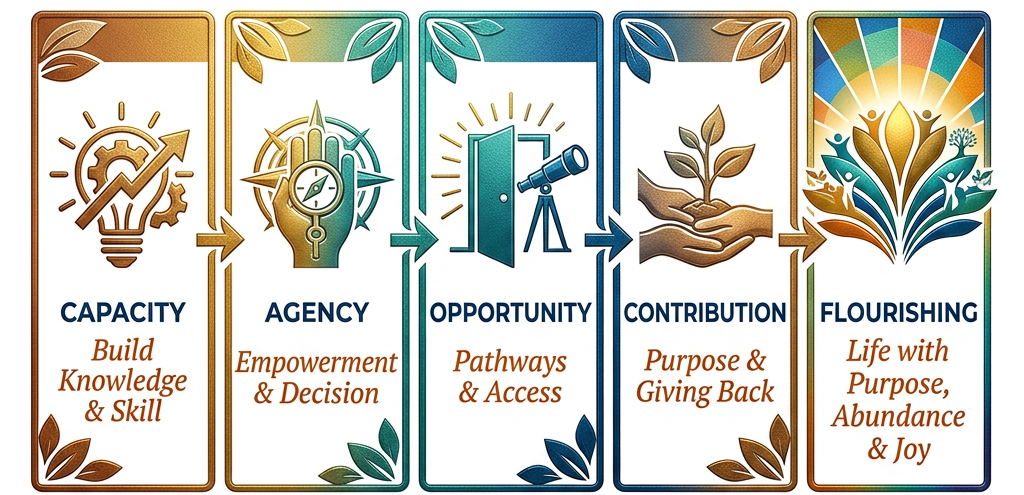
Capacity creates agency.
Agency expands opportunity.
Opportunity makes meaningful contribution possible.
Contribution strengthens both individuals and communities.
And flourishing emerges when those capacities are cultivated across generations.
Viewed through this lens, education is more than the transmission of knowledge.
It is the development of people.
Why Still Rising Institute Exists
Still Rising Institute exists because we believe these questions deserve deeper exploration.
Through our extended learning partnerships, transition programs, family engagement initiatives, and student development experiences, we are not simply delivering services. We are testing, observing, and refining the conditions that help young people develop confidence, initiative, ownership, community responsibility, and agency.
Rather than treating educational programs as an end in themselves, we view each partnership as an opportunity to learn alongside students, families, educators, and communities about what helps people move from participation to authorship and from opportunity to contribution.
Over time, this work has led us to revisit a distinction that appears repeatedly throughout history:
The distinction between navigating and building.
A navigator asks:
How do I succeed within the opportunities available to me?
A builder asks:
What needs to exist that does not yet exist?
A navigator learns the rules of participation.
A builder expands what participation makes possible for others.
Students will always need to navigate.
But thriving communities also need builders.
People capable of organizing, creating, leading, contributing, and imagining what does not yet exist.
What We Intend to Build
Still Rising Institute was founded as both an educational organization and a research institution.
Our educational programs provide opportunities to learn alongside students, families, educators, and communities.
Our research agenda seeks to better understand how agency develops and how educational experiences shape people’s capacity to act, contribute, create, and lead.
Over time, we intend to work with schools, community organizations, families, policymakers, and researchers to identify the conditions that help young people develop ownership, initiative, community responsibility, and the confidence to shape their future.
We hope to translate those insights into practical tools, research frameworks, partnerships, and eventually certification models that help communities intentionally cultivate agency, not merely achievement.
We invite educators, parents, students, community leaders, researchers, institutions, and partners to join us in this work of inquiry, experimentation, and community building.
Together, we can begin identifying, testing, and strengthening the experiences that cultivate agency, ownership, and community capacity.
Because communities do not flourish by accident.
They flourish when people develop the confidence, capability, and commitment to build something larger than themselves.
We cannot predict every challenge, opportunity, technology, institution, or economy the next generation will inherit.
But we can help cultivate the capacities that allow people to learn, adapt, contribute, and build wherever they find themselves.
Perhaps the most important educational question is not:
What opportunities will our children have?
But:
What capacities are we responsible for cultivating before opportunities change?
About Education As It Is
Education As It Is is a series of essays from Still Rising Institute exploring education, agency, community development, and the capacities that help individuals and communities flourish.
References and Reading Recommendations
Anderson, J. D. (1988). The education of Blacks in the South, 1860-1935. University of North Carolina Press.
Franklin, J. H., & Moss, A. A. (2000). From slavery to freedom: A history of African Americans (8th ed.). McGraw-Hill.
Margo, R. A. (1990). Race and schooling in the South, 1880-1950: An economic history. University of Chicago Press. The literacy figures cited for Southern Black Americans were reported from census-based analyses showing illiteracy rates of approximately 76.2% (1880), 48.0% (1900), and 33.3% (1910). [nber.org]
Woodson, C. G. (1933). The mis-education of the Negro. Associated Publishers.